When Will Comet Lovejoy Pass Again
Newfound Comet Lovejoy Gets Brighter as It Streaks Near Earth
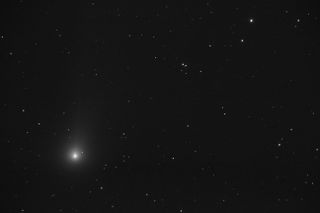
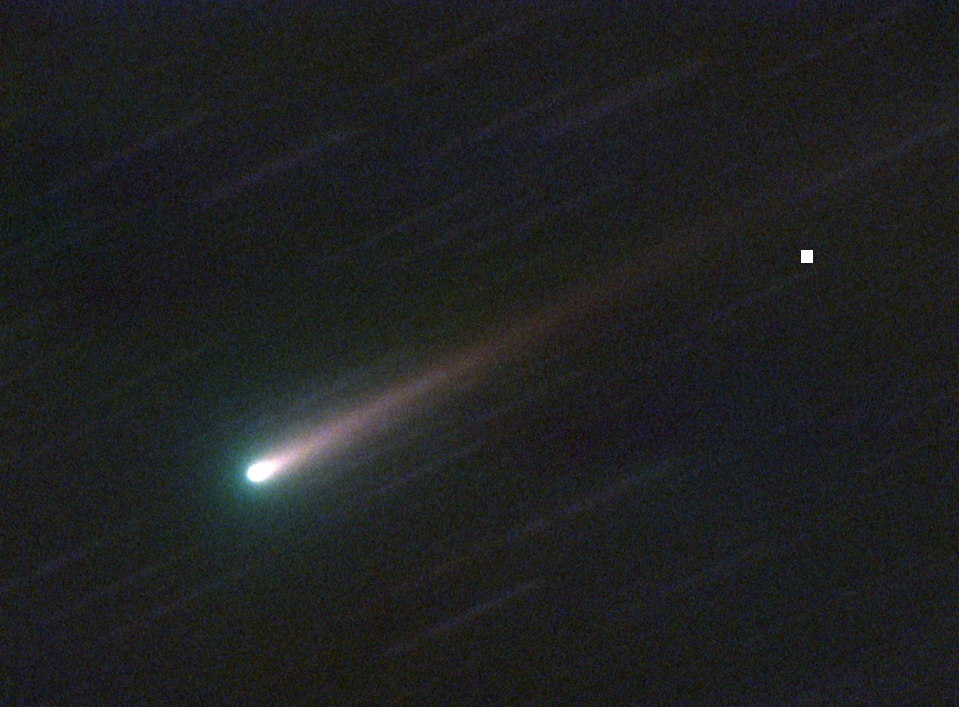
The potentially incredible Comet ISON has a companion in the morning sky.
The morning sky currently plays host to a newly discovered comet, which is at the present moment is really higher in the sky, noticeably brighter and easier to come across than the almost-ballyhooed Comet ISON.
The new comet was discovered past Australian amateur astronomer Terry Lovejoy. Lovejoy discovered a spectacular sungrazing comet in Dec 2011 and discovered the one gracing the skies now, his 3rd comet, on Sept. 7. [Amazing Comet Photos of 2013 past Stargazers]
This i, designated C/2013 R1 was plant on CCD imagery to the southeast of the constellation Orion. Based on confirming observations from other amateurs, the comet was estimated to be around magnitude 14.4 — or nearly 1,600 times also faint to be seen with the unaided eye.
However, the new comet began to quickly brighten on its way in toward the sunday and will arrive at perihelion — its closest point to the sun — on Dec. 22 at a distance of 75.4 million miles (121.4 million kilometers).
Getting brighter
Every bit of Nov. half-dozen, based on a consensus of worldwide observers, Comet Lovejoy had reached magnitude 6.5, which is considered to be the threshold of naked eye visibility in a dark sky, far from any bright lights.
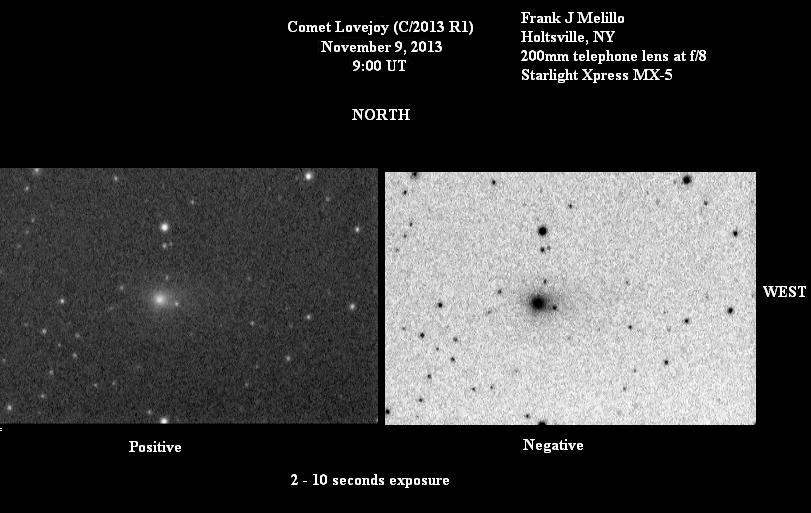
On Saturday, Nov. ix, Long Island observer Frank Mellilo headed out to look for Comet ISON, only discovered it was backside the roof of a nearby house.
"I was prepare to wrap it up for the night," he wrote, "Merely then I remembered about Comet Lovejoy. It was right under my nose while I was waiting for ISON. I took my 10X70 binoculars and I got the comet correct away. Information technology has a faint smudge tail to the west. And so at least, I wasn't disappointed by not sighting ISON! Information technology's worth taking a look at Lovejoy!" [Astonishing Nov Nighttime Sky Photos past Stargazers]
The new comet is getting progressively brighter with each passing day. This is considering while en road to its Dec. 22 rendezvous with the sunday, Lovejoy will brand its close approach with World on Nov. xix, when it will laissez passer within 36.ix million miles (59.iv one thousand thousand km) of the planet.
At its all-time around that time, Comet Lovejoy "might" go as bright as magnitude 4.5, all the same a moderately faint object, even so bright enough to be glimpsed with the naked centre and certainly a fine object for binoculars and small telescopes.
Unfortunately, the moon volition exist two days by total that forenoon and well up in the w, lighting up the sky, probably preventing whatever naked eye viewing opportunity.
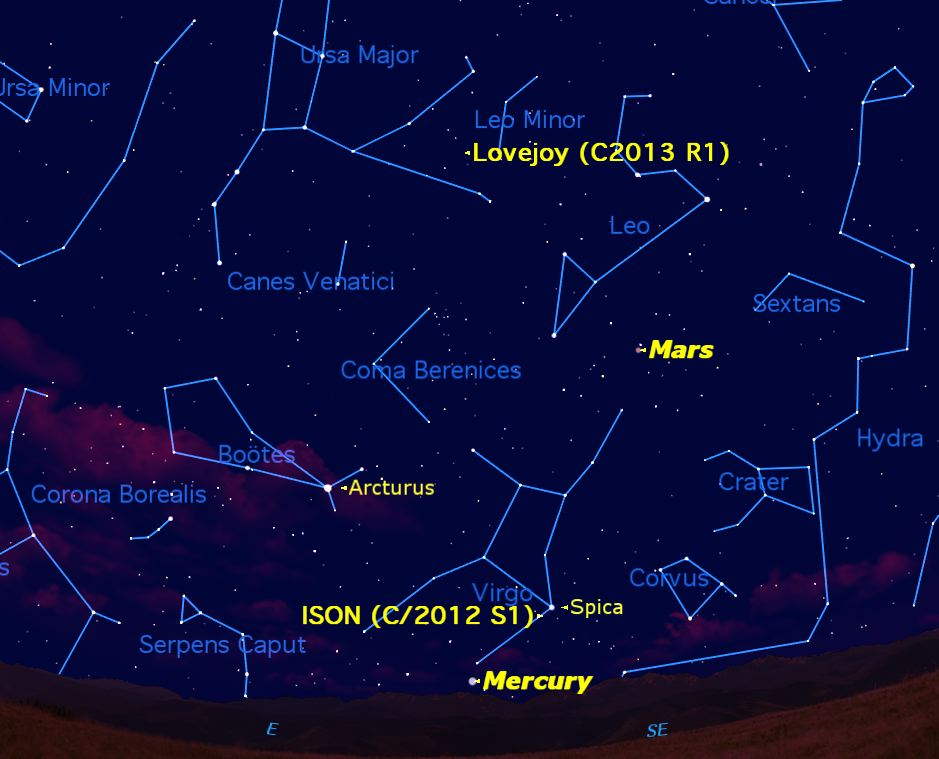
After crunching the numbers based on the latest set of orbital elements from the Pocket-size Planet Heart, in the coming days, the comet will be moving northeast through the constellations of Leo and Leo Small.
Next Sunday (Nov. 17), stargazers volition be able to locate Comet Lovejoy using the Large Dipper, which will exist standing on its handle high in the east-northeast sky just before the suspension of dawn. Past extending an imaginary line through the ii stars at the terminate of the dipper's basin — the famous "pointer" stars, Dubhe and Merak — to the n yous would come to Polaris, the North Star.
Only on Nov. 17, extend the line the other way, about four times the altitude between the ii stars; Lovejoy volition be a short distance to the west (correct) of this line. With binoculars, look for a fuzzy patch of light with an almost star like centre and peradventure a faint appendage extending upward and to the right of the center. That is the tail of the comet pointing abroad from the sun.
A slow farewell
Afterward that, the comet will continue to race northeast into the constellations of Canes Venatici on Nov. 21, then, every bit information technology moves away from the Globe it will tedious downward every bit heads east, then southeast into Bootes on Nov. 27, cuts beyond Corona Borealis December. 4-11 and then into Hercules, passing a few degrees south of the quadrilateral of stars popularly known as the "Keystone" on Dec. 17.
During all of this time equally information technology moves away from the Earth, information technology will be fading — though very slowly — probably glowing between 5 and 6 magnitude, just barely visible to the centre on dark, clear nights.
Simply Lovejoy may very well be overshadowed at that time by Comet ISON, every bit the 2 comets will passing each other between December. 18 and twenty. They won't get much closer than ten degrees from i another, and Lovejoy should exist just a faint, fuzzy blob, while observers hope that ISON will have evolved into a lovely celestial showpiece by so.
Incidentally, based on latest orbital calculations, Comet Lovejoy is not due back for at least 7,000 years. So if you miss it on this go around, don't expect up for it.
Editor's note: If you snap an amazing moving picture of Comet ISON, Comet Lovejoy or any other night sky view that yous'd like to share for a possible story or image gallery, send photos, comments and your name and location to managing editor Tariq Malik at spacephotos@space.com.
Joe Rao serves as an instructor and guest lecturer at New York's Hayden Planetarium. He writes nigh astronomy for Natural History magazine, the Farmer'south Almanac and other publications, and he is also an on-photographic camera meteorologist for News 12 Westchester, Due north.Y. Follow us@Spacedotcom ,Facebook and Google+ . Original article on SPACE.com.
Bring together our Space Forums to keep talking space on the latest missions, night heaven and more! And if yous have a news tip, correction or annotate, allow us know at: community@infinite.com.

Joe Rao is Space.com's skywatching columnist, as well every bit a veteran meteorologist and eclipse attorney who also serves every bit an instructor and guest lecturer at New York's Hayden Planetarium. He writes about astronomy for Natural History mag, the Farmers' Annual and other publications. Joe is an eight-time Emmy-nominated meteorologist who served the Putnam Valley region of New York for over 21 years. You lot can find him on Twitter and YouTube tracking lunar and solar eclipses, meteor showers and more. To detect out Joe'south latest project, visit him on Twitter.
courticechand1991.blogspot.com
Source: https://www.space.com/23580-comet-lovejoy-visibility-night-sky.html
0 Response to "When Will Comet Lovejoy Pass Again"
Post a Comment