Italian Renaissance Lady Wearing a Green Velvet Dress
Fifteenth-century women's dress
Fra Filipo Lippi's Portrait of a woman (Fig. 3), painted around 1445 is a touchstone for fifteenth-century female beauty and dress. The unknown sitter's lips and cheeks have been lightly rouged with cosmetics to highlight her youthful glow. Her fair complexion, bright eyes, rosy lips, and blonde, expertly-coiffed hair all refer to a popular fictional late Medieval lady, Laura. Petrarch describes his muse, Laura, in his humanist poetry collection Il Canzoniere or song book. Laura is also portrayed as perfectly virtuous and chaste in Petrarch's poems, which enhances her unearthly beauty. This book was so popular in Renaissance Italy it inflected beauty standards; thanks to Petrarch's ladylove, early modern gentlemen preferred blondes. Even Christ's mother, Mary, is depicted with golden hair in most period paintings. Women dyed their hair to achieve the desired tone. The Trotula, a twelfth-century text on women's medicine, advises:
"For coloring the hair so that it is golden. Take the exterior shell of a walnut and the bark of the tree itself, and cook them in water, and with this water mix alum and oak apples, and with these mixed things you will smear the head (having first washed it) placing upon the hair leaves and tying them with strings for two days; you will be able to color [the hair]. And comb the head so that whatever adheres to the hair as excess comes off. Then place a coloring which is made from oriental crocus, dragon's blood, and henna (whose larger part has been mixed with a decoction of brazil wood) and thus let the woman remain for three days, and on the fourth day let her be washed with hot water, and never will [this coloring] be removed easily." (Green 115)
Notice also that the hairline in Portrait of a woman is unnatural. Fifteenth-century women often plucked or shaved their hairline back several inches, towards the illusion of a lengthy forehead, a sign of intelligence. She has severely tweezed her eyebrows to complete the effect.
The dress style in Portrait of a woman is typically fifteenth-century. Fashionable gowns positioned female waistlines above the hips, accentuated the waist with a belt or girdle, and generously poured uninterrupted volumes of fabric towards the feet (Landini and Bulgarella 90). These gowns, which are referred to in period inventories as a gonna, gonnella, sottana, gamurra, or cotta interchangeably, could be hemmed at the ankles or floor. A wealthy early modern woman wore at least three—often four—complete layers of clothing in public. On special occasions a woman would wear another gown atop the gamurra called a giornea, usually patterned and made of velvet or silk brocade. The unknown figure in Portrait of a woman wears a green gamurra, while Giovanna da Tornabuoni (Fig. 4) wears both layers in her portrait. A woman's exterior-most gown was the most expensive and ostentatious, as it faced the evaluating world (Frick 162). An outer garment alone could require eight braccia, or a little over five yards (4.5 meters) of fabric. Beneath their sumptuous gowns, women typically wore a chemise or camicia (Fig. 5), an undershirt that pressed directly against the skin. The white fabric peeking out from under the larger, green sleeve worn by Lippi's sitter is an example. Between the camicia and gamurra women usually wore another over-dress. An upper-class woman's clothing was thick, voluminous, and dense.
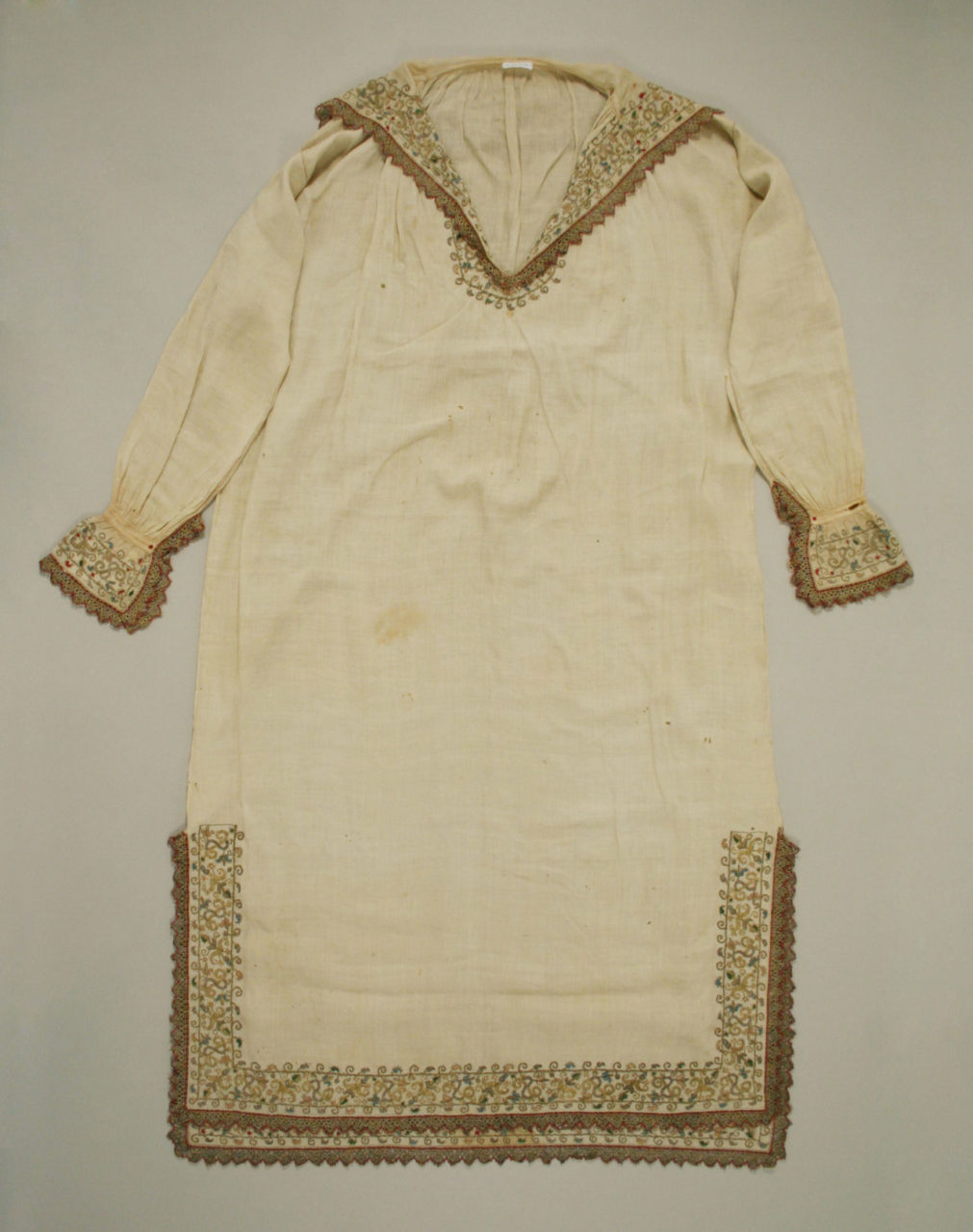
Fig. 5 - Maker unknown (Italian). Camicia or chemise (shirt), 16th century. Linen, silk and metal thread. New York: The Metropolitan Museum of Art, 10.124.2. Rogers Fund, 1910. Source: The Met
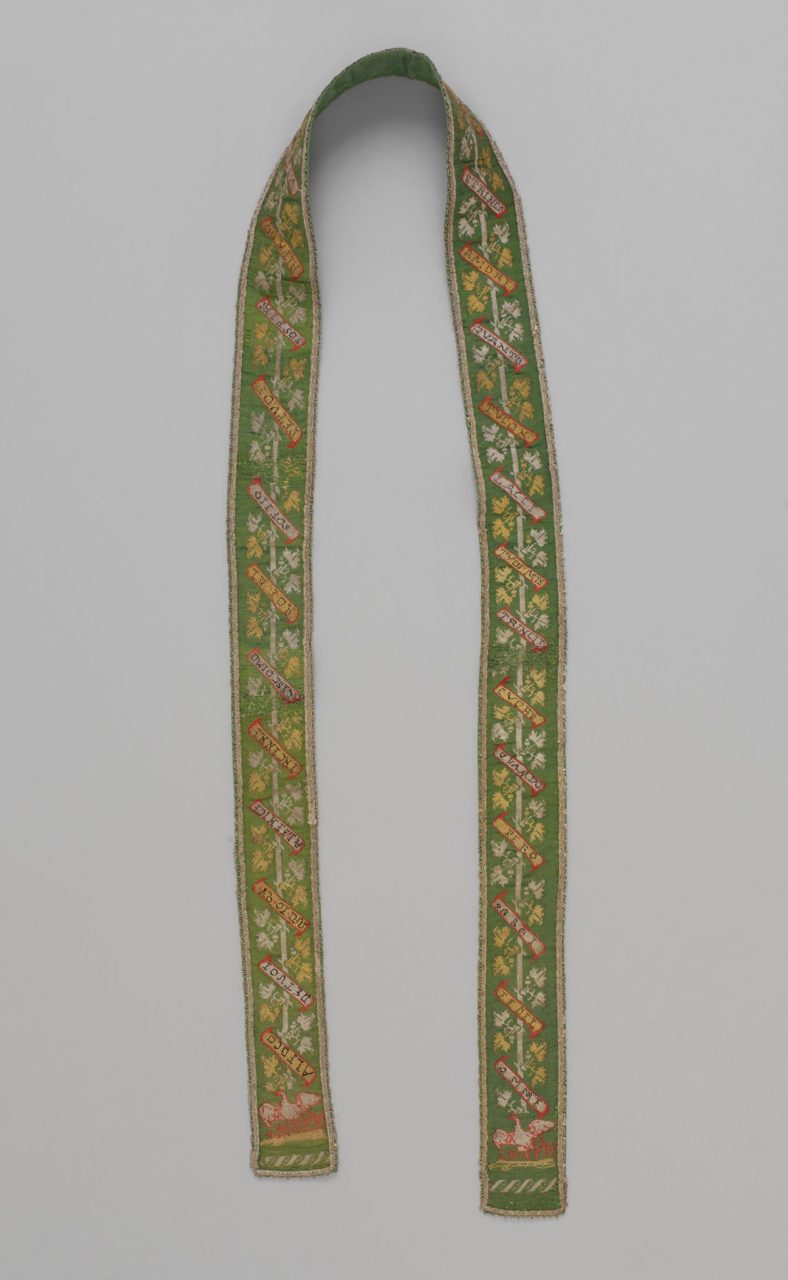
Fig. 6 - Maker unknown (Italian). Belt or girdle with a woven love poem, 16th century. Tapestry weave band with silk and metal thread; 167.6 x 6.4 cm (66 x 2.5 in). New York: The Metropolitan Museum of Art, 46.156.73. Fletcher Fund, 1946. Source: The Met
While the ensemble in Portrait of a woman may seem simple at first glance, it is in fact very lavish when considered within the context of the fifteenth century. Her overgown is dyed a vibrant shade of green, as bright jewel-tones were very popular for women's clothing during the Renaissance. Pleats begin just below the breasts and expand at her waistline. Her long sleeves are a symbol of wealth and status, as the extra fabric hinders manual labor. Her skirts bunch and spring from her waist. Neckline and sleeves are lined with a thick fabric, perhaps muslin or even fur. Small, decorative holes are bored into her belt and undershirt. A strand of identical pearls hangs from her neck. Though the sitter's hair is covered, viewers can assume it is arranged in a complex up-do. Two types of lace make up the headdress, one porous with seamed holes. A sheer lace veil sweeps around her neck. The veil symbolizes her adherence to humility and religious norms. A closer look at the veil reveals how very expensive this accessory was: tiny pearls trim its outer edges and line the main body.
Portrait of a woman may be a marriage portrait. The sitter's hands are dotted with six rings, which were exchanged during Renaissance engagement and wedding ceremonies. Her pinned-up hair also possibly attests to her wedded status, as young Italian women only wore their hair down to announce marital availability. Further, the pearls she wears on both her necklace and headdress may also be read as potent symbols of sexual purity. Across Western Europe, young women wore pearls to broadcast their virginity, considered the most desirable trait in marriage negotiations. Her white, stippled belt may be a further marker of chastity. Belts were closely associated with marriage, sexual virtue, and pregnancy, and were commonly given as gifts from groom to bride, such as this example in the Metropolitan Art Museum's collection (Fig. 6), which bears a love poem stitched in precious metal. Women were expected to be unflinchingly loyal to their husbands. While men often waited until mid-life to marry (so that they had time to grow their estate or business beforehand), marriage age for Renaissance women was late adolescence or early adulthood, with the optimal ages for best childbearing potential falling between fifteen and nineteen. If an upper-class woman was fortunate enough to have her portrait made, it was likely in celebration of her engagement or wedding. Lippi's sitter, then, is likely a teenager.
Lavinia Fontana's Portrait of a noblewoman (1580) showcases sixteenth-century Bolognese fashion (Fig. 9). A high collar and stiff, starched ruff surround the sitter's face. A jeweled headband crowns her head. Her dress may be a wedding dress, as burgundy was a popular color for brides. This woman is careful to respect period sumptuary laws (civil restrictions on what could and could not be worn in public); women were only allowed to wear multiple necklaces if one hosted a cross (Murphy 96).
A small dog perches on her skirt beneath her caress. This animal is yet another signal to the viewer that this woman is extremely wealthy. Upper-class women often kept little dogs as luxury pets, as they were too small for hunting and thus only useful as companions and living accessories. The dog itself wears a gemstone collar. The creature is also symbolic of marital fidelity, as the animals were considered naturally loyal. The need to preserve a woman's chastity was still tantamount throughout sixteenth-century portraiture.
It is possible the bejeweled martin head hanging from her belt (a popular accessory for women in the period) symbolizes pregnancy or the promise of future pregnancy (Musacchio 172). The head swings directly below her womb. Martins and weasels (a Renaissance person would not have made a distinction between species) were thought to reproduce rapidly, and so this fashionable accessory may double as a quasi-magical token used to generate future progeny. Ermines were also symbols of purity.
Clothing and jewelry, however, are the true subject of Portrait of a noblewoman. Every facet of every jewel, every stitch of the gown is rendered with high accuracy. Caroline Murphy argues that the extensive detail paid to the elaborate gowns and jewels of Bolognese noblewomen by Lavinia Fontana act as painted dowry inventories (Murphy 88). A dowry was a case of luxury items and cash a bride's father exchanged with her groom. Upper-class Renaissance women did not work, but social norms required she wear ostentatious clothing in public. Clothing a wife was expensive, so families would often off-set the cost by providing the young bride with a set of clothing and jewelry to start her new, married life. In early modern Italy, it was possible for a woman to regain her dowry after her husband's death, the first time in her life that she had access to its wealth. Paintings like this, therefore, may be so meticulously and precisely rendered to prove what made up the dowry, should its contents ever be called into question (Murphy 88).
Together, these images explain how fashion was bound up with beauty and social expectations for women. Female portraiture depicts not specific individuals, but rather their lavish clothing and jewelry. Women were meant to be decorous and decorative. Virtue, familial expectation, and attractiveness were deeply conflated. Leon Battista Alberti states in Della Famiglia, a treatise on living well (began 1432), that what makes a woman beautiful is potential fertility:
"Thus I believe that beauty in a woman can be judged not only in the charms and refinement of the face, but even more in the strength and shapeliness of a body apt to carry and give birth to many beautiful children." (122)
In the very next line Alberti adds that "the first prerequisite of beauty in a woman is good habits" (Ibid). Alberti would have agreed with the mantra: "Beauty adorns virtue."
courticechand1991.blogspot.com
Source: https://fashionhistory.fitnyc.edu/beauty-adorns-virtue-italian-renaissance-fashion/
0 Response to "Italian Renaissance Lady Wearing a Green Velvet Dress"
Post a Comment